
Year of 2020 will be remembered for long. COVID-19 was able to stop the economy wheel relatively not for such a long period of time but we will have to cope with financial consequences probably for years.
Many countries were already having debt problems as reminder of previous financial crisis of 2008. And the current pandemic will push not only the government debt to the limit but also national balance deficits of many countries. Astonishing financial help already came from US and European Union for businesses and workers. Combined efforts wouldn’t be less than 2 trillion USD. Important to mention that central banks in both mentioned areas also promised to provide liquidity and necessary funding as big as it requires. No limit in this promise. Money printing will be pushed to new heights. Seems like during last decades debt question step by step became an elephant in the room and just small number of politicians are willing to talk about it.
From economical point of view controlled level of debt is unescapable situation for many countries. And it’s even a positive situation when you need to create economic growth without sufficient funds for that. In situation like, investing in important infrastructure, security or big development projects that will be beneficiary for many years in the future and for many people. Government generally needs to gather larger pools of funds than it has on its own balance sheet. So borrowing in these circumstances, economically makes good sense as future benefits will cover the cost of it. However, in many examples from current world and history we see that all borrowed money rarely are used very wisely. In the past we had not so little examples of countries who declared bankruptcies. Probably we will see them as well in the future.
The situation this time I believe is a bit different as such huge amount of debt never was so wildly spread all around the world and especially among developed countries. And when we look into the debt more broadly, expanding from governments to corporates and private households. Numbers are even more impressive (chart from Bloomberg)
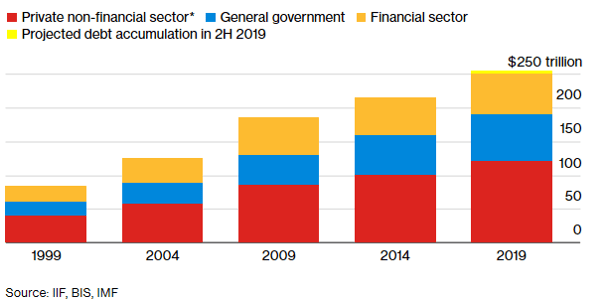
How for governments around the world is possible to serve their debts and create conditions for their citizens and cooperates to manage their liabilities? Firstly, print more money to repay debts but this might cause an unexpected inflation and the loss of credibility. Secondly, borrow more to cover current debt and service costs. Doing that not accurately will cause credibility questions as well. Worth to mention that record low interest not only gives more money for economy expansion but also increases the debt drastically. And then we have the situation. When it’s not so easy to repay or refinance debt with low interest, which might be mission impossible to do it with growing interest. Part of central banks are just unable to lift interest and for this reason. Thirdly, an increased budget from growing economy can cover increased service costs of debt. Two first mentioned scenarios are very carefully watched by many around the globe and any misbalanced actions there will call up attention and potentially harmful actions from investors and creditors. While the third one is a very welcoming and economically well-grounded scenario. I believe every country would like to see this scenario but not always it’s happening.
There are many economy growth theories and most of them explain the growth very reasonably. From a classical Adam Smith theory to Endogenous or Keynesian demand growth theories. If one view is more focusing on demand supply aspects another ones will include other very important factors. All of them together will combine a comprehensive view. Most often operating components are capital, labor, investments, savings and technological innovations. I don’t want to argue which component is more important than others but I will express my opinion with a bigger focus on population and innovation. As I believe population and technology currently are quite hot topics.
Population growth together with a labor force increase very often is one of the key factors and motives for economy to expand if a juridical and financial stability, predictability are ensured in the country. If country is relatively reliable, predictable and guaranteeing private property rights eventually with the help of an available labor force will experience an economic activity growth as it need to serve an increasing demand from internal and external consumption. Core broad factors influencing demand’s increase always will include global consumers or simply population of the world increase and/or increased and/or changed consumption habits of existing users. For that reason substantial part of the economy growth is directly related with population growth. Even for countries which don’t experience any labor force growth but can exhibit high and growing numbers of GDP per capita will probably see an increased demand for goods and services from outside or driven by investments made in other countries and profits earned also from users around the globe. For that reason we simply cannot separate these two parts as they are directly related.
Of course, meaningful part of economic growth is driven by technological innovations as well. What makes our goods and services not only more advanced but most importantly their production is becoming more cost-efficient. From innovations perspective we should be able to experience that with already existing resources we are able create more. And idealistically future innovations should be financed by the savings.
However, already living for a decay or two with technological innovation wonders presented almost every day. Transformations of older working or manufacturing principals are effecting almost every company in all countries and words such as agility or robotics are becoming a new norm in working environment. With such dynamics I personally would expect that at least the consumption of raw earth materials could be stable or decreasing. But the reality is completely opposite. Which is proposing the idea that either technological innovation change is simply not efficient enough and more focused on front end than on back end efficiencies or we are consuming more with increasing number of consumers in general. I would say that these two mentioned conditions are going in step.
Global debt burden is drastically increasing together with increasing population and its demand. Countries with a need to service an increasing debt are dependent on an increasing population not necessarily in their own country but at least somewhere globally. Paradoxically, when the population is increasing you need to invest even more in infrastructure and other extremely essential and long lasting projects. Where again the borrowing is becoming a most attractive option. Where the corruption is flourishing in these conditions.
It’s essential to figure out sooner than latter how to escape this trap. When the parameters of population, consumption and debt are increasing almost exponentially, something will fall down hard and quickly. Politicians avoiding confrontation situations are simply waiting for force major to act drastically. They will be able to put the blame on nature or unexpected circumstances with the relief. With such incapacity we will face much bigger shocks than COVID-19 in the future.