
Financial institutions enthusiastically and often righteously are showing off their involvement in an environmentally and socially responsible governance practices (ESG). The ones that should ensure the delivery of sustainable, socially responsible and transparent banking operations throw all units of companies. Although, when the topic comes to the areas as fossil fuel sector financing and involvements in non-green energy projects we no longer hear any advertising word of how banks are proud and happy of helping to finance new oil exploration sites and gas pipelines. Aren’t they doing business with fossil fuel related sector anymore?
Looks like the biggest part of business reality is still left in the shades of annual reports with as much as possible generalized abbreviations. However, articles in newspapers and advertisements will humbly mention how particular bank managed to reduce paper usage in their organization or planted few hundreds of trees in the park nearby.
From the social point of view, double standards in financial institutions activities were and probably will be the part of the financing practices made in the name of profit for shareholders. Money world has a “slightly” different interpretation and measures of social activities compared with the society. Rational decisions to earn more and generate higher returns to investors will have a more encouraging initiative compared with a strict and core ESG agenda in all functions of any financial institution.
I would call a current wave of strive to comply with at least some part of ESG agenda is a new fashion in financial sector and essential step to at least keep the existing clients. On the other hand, the seriousness of how ESG policies are incorporated and actually implemented in day to day business, depend on our society and us as regular customers. Just we can level up the way banks and other companies are working and disclosing information in fully transparent manner.
Meaningful part of financial institutions are positioning them self as future advocates and examples of how to implement ESG requirements into business models. However overlooking around dozen of banks and their real engagement to the ESG, we will notice that factually it is very fragmented. Often the focus is narrowed to the niche parts of their business or areas where substitution of an ESG unfriendly asset is easily manageable. Firstly, big part of banks introduced ESG policies to their asset management teams mostly related with requirements: not to invest in certain type of companies such as guns producers or fossil fuel manufacturers, to vote in annual general meetings as representatives of assent management customers. However, we should not forget that in global markets all asset managers are exposed to limitless investments substitutes. In that sense, this implementation is achievable almost effortless.
Secondly, banks introduced new and very trendy product, which gives one more opportunity to attract more money for financing activities. It is called green bonds. Proceedings of this kind of bond issue are allocated exclusively to environmentally sustainable projects. However, other regular oil and gas industry financing activities take place shoulder next to shoulder with green bonds. Thirdly, just several banks of many began to ban broader financing activities to coal based energy production related projects. That sounds as an action tackling just the tip of the iceberg, while whole problem is still underwater.
Going to the disclosure of some real numbers how banks are involved in the oil and gas industry financing, we will face the tremendous information shortage in their financial reports. Financial institutions tend to hide these numbers quite carefully in an income statement and not to disclose them directly by grouping financing activities by different cuts not involving clear gas or oil industries exposures. Below are numbers gathered by the Guardian which are representing financing activities of USA banks. Looks like numbers simply speaks for them self.
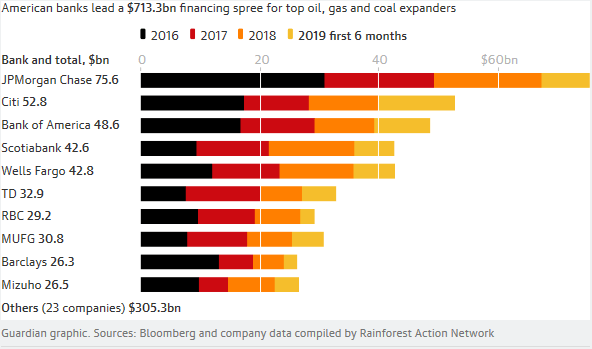
Let’s turn the view from United States a nation with quite pragmatic economic relations, to one of the first and biggest global worming advocates in the world – Denmark. I found it quite clear that even in Denmark is not so hard to spot mismatches between the real situation and the ESG facade. The biggest Denmark lender, Danske bank, which proudly promotes its huge progress in ESG practices integration into its business and products, somehow is avoiding mentioning that substantial part of its revenue comes from industries related with fossil fuels.
Till the end of 2019 Danske bank has issued green bonds and loans with the value reaching roughly 1,3 billion EUR while gross credit exposure into an shipping, oil and gas industry (annual report isn’t providing more precise sectors division) is around 6 billion EUR. Moreover, annual report is providing ambitious plans to increase issues of green bonds substantially, and this promo information is exposed of course in CAPITAL LETTERS. However, no words are mentioned how Danske bank will tackle oil and gas industry clients.
To associate with an ESG direction is nowadays a quite often employed position of companies in general as it is a new trend. It is easy, convenient and not too expensive to promote one progressive and morally firm part of the business and simply not to mention all other sides, which generally are accompanied by wild pragmatism and profits.
It might sound that in these circumstances companies are risking to lose the engagement of employees who have a better inside information. However to play two-face game on corporate level isn’t so difficult from personal perspective either. In bigger entities, responsibilities are distributed among many. Passionate identification with good and responsible mission of some small part of activities can be easily absorbed as a whole and indivisible vision of all business. Besides, an individual can easily escape personal moral voice by associating with bright side of the company. In addition, we should not forget that a huge motivator in this employer and employee relationship is the salary.
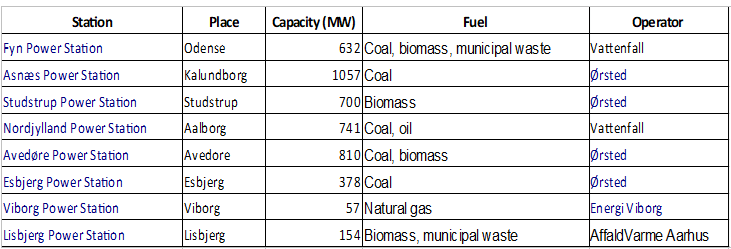
Keeping our noses still in Denmark, one of the most visible promoters of environmentally sustainable policies all over all chapters of country activities, I would like to switch to the more obvious example – energy sector. The biggest energy provider in Denmark is the company named Ørsted, which is also a big player in wind power plant constructions. If you would visit their web site, you could almost feel the boost of a fresh air from exceptionally and solely a wind power orientated information provided in it. In addition, by googling in general it was almost impossible to find any information about Ørsted’s fuel sources which company uses to generate electricity to the customers in Denmark. After searching more persistently, I found a much less encouraging company view. Putting away the big involvement and even bigger plans of wind energy projects, Ørsted is still the main provided of coal-based energy in Denmark. Table below represents Denmark’s fuel-burn power stations with capacities, fuel types and operators. Most of them belong to Ørsted.
Corporate world is scared to be more honest and transparent, always choosing easier way to talk only about few positive things and leaving topics that are more problematic silently in the corner. Companies tend to emphasize small ESG compliances as a cardinal change of business models. What might show a weak hand in the perception of the reality, together creating a more vulnerable business model to any type of controversial situation.
We cannot ignore the fact that we are dependent on energy and we will produce it from all possible fuels we would manage to get. We won’t cut our consumption instantly and would be naive to expect that. However, our governments should guarantee a real, fair and transparent picture of businesses. Acknowledging and seeing real situation every day would easier empower each individual to think and act in much more responsible way than we act today. Knowing well and accepting controversial parts of any behavior can bring changes much quicker and easier compared with the changes when you even don’t know what exactly is wrong.