
„My dear, here we must run as fast as we can, just to stay in place. And if you wish to go anywhere you must run twice as fast as that.” That’s kind of advice the Alice was given in Wonderland. That’s kind of reality biggest economies of the world are facing now on every month’s growth challenge. Durability of our economy growth in the context of COVID, natural disasters and many other uncertainties looks more fragile than ever before.
Tremendous support for businesses, individuals and all government agencies was required and fulfilled during harsh years of 2020 and 2021. Unexpected pandemic brought the entire world into an unknown territory of full shut down and such situation required unprecedented actions from governments. Financial aid was provided almost to everyone who was in need. Countries still offer different forms of financial support to broader society currently and most likely, that it will extend until the end of this year. Moreover, it is likely that more help will be extended if COVID situation will deteriorate.
Below is the graph showing GDP annual growth of United States and European Union for the last 25 years.
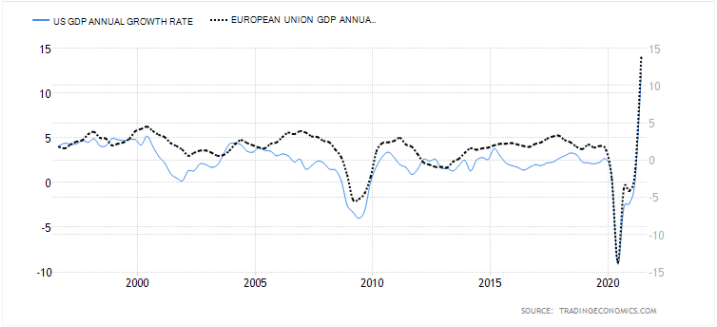
Curves clearly shows how governments swiftly react to every real economic downturn and are giving all they have just to make an economic reversal as soon as possible. However, very little are discussed what are the costs of such savior position and if these efforts will not come back with a much harder slam for many. The concern arises first of all for the strength and sustainability of the economic recovery and major financial measures.
Solely through a COVID global pandemic period United States were infusing fresh dollars at the pace that was never seen before. It doubled the liquidity in the markets in less than 2 years and if we would compare FED balance sheet with a year of 2008, just before financial crisis of 2008, the factual change is reaching 8 times. Federal Reserve’s balance sheet shows how much money provided for the markets by the central bank with the bonds buying activities. The FED balance sheet chart is below. Nether the less, during year 2020 fiscal spending, related with the crisis, was 2.6 Trillion USD, taxes reduction 3.5 Trillion USD, extra loans funding 3.9 Trillion USD. Probably it’s not really necessary to add any additional proof to confirm the picture of money pouring from the US government sky.
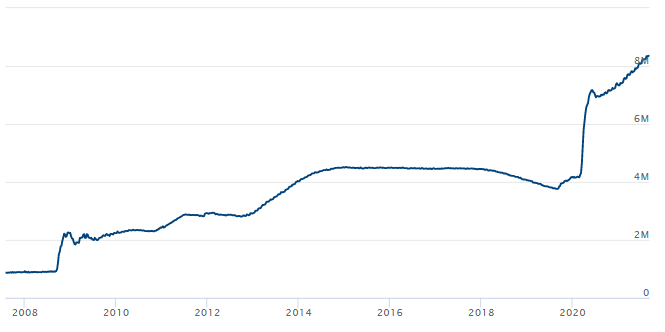
Source: www.federalreserve.gov
European Union as well as other major world economies were following the same footprints. EU fiscal instruments for the COVID recovery now have reached 2 Trillion EUR. ECB balance sheet during pandemic changed almost by 3 Trillion EUR. We should keep in mind that gargantuan support and money kicked-in in each European countries individually.
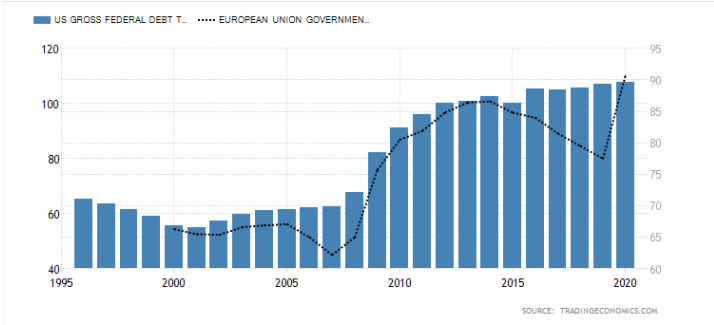
All these lifebuoy actions made a clear footprint on debt to GDP measure. Where government debt to GDP measure has reached levels well above 100 percent in the United States and almost touching this mark in European Union. Graph below.
Economical struggles of last two years were significantly growing debt not only for governments all around the world but it has peaked in corporate world as well. Corporate debt to GDP ratio in the Unites States reached all time high with 235% in 2020 and in Euro zone, this measure has topped 100.5% mark.
Such enormous number off financial stimulus and debt have given back for now relatively moderate growth of major world economies. Looks like that the effect for now could be described as a fragile stabilization. US in August 2021 has just reached absolute per-pandemic GDP number and Euro zone for now still lacks few percent to match this mark. However, at this point arises few important questions. Will we need some debt relieve eventually. When will come the time then growth won’t be able to cover all financial support and help measures. Why are we spending much more funds today just to maintain less funds in the future?
First signs of such stimulant economies are directly beginning to bite all of us in the form of inflation. For now, these numbers and the reality are manageable. In the United States latest annualized 12 months inflation rate has hit 5,3% (August 2021 CPI). In EU August, annualized inflation has reached 3%. Until today, these numbers are still relatively moderate. However, trend of some raw material prices are indicating that a much darker future lying ahead. Oil has jumped more than 100%, natural gas price has increased by 150% during the last year. Wheres we are still approaching winter season, when these prices have a tendency to peak relatively during all year period. Another increasing prices reality spotted in most of real estate markets and international shipping rates where prices were hitting some old time records. There is no doubt we will face much more surprises in the nearest future. When the sun of the inflation might begin to sting. Should we, in this context expect significant devaluation on major world currencies? The time will show.
Even if we blindly believe that current and extremely expensive situation somehow will be covered by future generation. The reality of devastating worldwide events, that are stretching the limits of every countries balance sheet deficit, seems to be gloomy. The frequency of sizable and costly nature related events are dramatically increasing. Especially we can notice this from climate change angle with the emphasis of extreme weather incidents. According to the UN Environment Program an estimate cost of adaptation to the climate change worldwide can reach up to 0.5 Trillion USD yearly from the year of 2030. These figures exclude the potential loss of biodiversity and cultures, what is very hard to evaluate.
Increasing number of unpredictable factors in our economic and social life is evidently suggesting that some economical bleeding should be expected. Conscious path might be a better choice. As it is safer to manage the process when we are expecting some midterm economical reversal, rather than facing unanticipated fall down. However, for now it seems that we are aiming for a surprise. We will be concluding our never-ending economic growth cycle probably this decade.