
Debt cracks
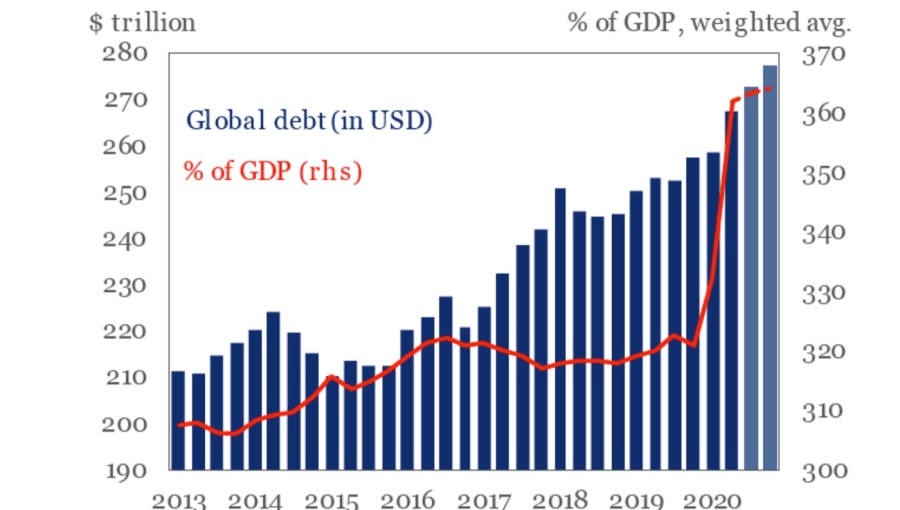
It’s more than one year that we are living with a COVID pandemic. Many things have changed, specially our habits, behavior, psychological condition and by all means we shouldn’t forget to mention – the debt of our countries. Governments, companies and households raised $24 trillion last year to offset the pandemic’s economic toll, bringing the global debt total to an all-time high of $281 trillion by the end of 2020, or more than 355% of global GDP, according to the Institute of International Finance.
How we will end up with a still lasting COVID quarantine, new COVID variants or even more severe new viruses? Can it be the beginning of mass bankruptcies, huge inflation and currencies devaluations? These and many other questions related with our economics future arise in our heads every time new stimulus are presented.
Let’s have a look how much exactly governments of major economies are indebted for this date. EU combined debt – $ 14 trillion; US government – $ 28 trillion; China foreign debt – $ 3 trillion however, the structure of the debt in China is quite oddly structured and numbers are grouped in different order compared with the rest of the world; Japan government debt – $ 12 trillion.
Global debt meaningfully increased from around $ 210 trillion to $ 281 trillion just during last 5 years period. How much this tremendous increase is unbalanced, especially huge effect of COVID crisis, very well appears when we diverge from absolute numbers and add debt of GDP in %. The graph below presents this situation clearly.
Source: the Institute of International Finance
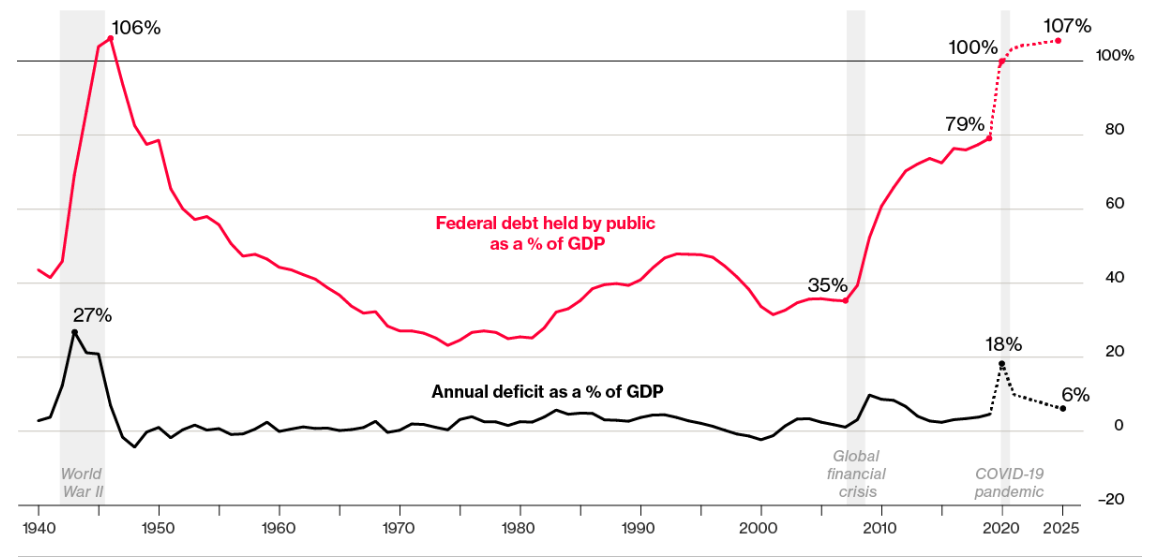
One more breathtaking and together frightening data set suggests that on government debt level and deficit numbers, US metrics are almost similar to the second world war conditions, where debt projections are expected to exceed economic output.
Source: Bloomberg.com
Of course, big difference in this comparison stands in the conditions of an environment and an infrastructure where economies will be left to operate after the critical moment. The chances of a relatively quick recovery this time are way higher, however the financial burden left on the shoulders of countries looks evenly heavy.
Concerning thing about governments reaction to the pandemic is the magnitude of the borrowing. The same graph of a US federal debt held by public as a % of GDP reveals the tendency of latest decades – borrow and spend every time economy tumbles. Global financial crisis gave initiation of reckless borrowing and the debt increased more than twice during the last decade. COVID is pushing borrowing to the same margins again. We haven’t experienced any period of reversed situation and probably won’t see it in the nearest future.
In these conditions the main anxiety that occurs in my mind is the lack of trust of the current fundamental economics status quo. Money, debt, other valuable assets and their perceptions are very much dependent on a society trust in them or, at least, the society is relying on authorities that are keeping valuations stable and not too deviant. However, now seems that the wall of reliance is step by step cracking.
Bitcoin is probably becoming the symbol of alternative assets that are not reliant on any fiscal and monetary decisions made by whatever government. There are several reasons why more and more people are turning to crypto currencies with a real interest: including fashion, hope of quick fortune, sometimes stupidity and regular diversification. Very often institutions emphasize the lack of a value background of crypto currencies. However, one of most serious background of the valuation is very much related with an independence from those institutions. It might be, that bitcoin is a good barometer how people feel about governments capabilities to preserve value in economic goods. Those that institutions have created and now themselves are inflating limitless.
Nevertheless, we shouldn’t forget and the most classic value preserver when monetary products are failing – gold. Which has spiked in the COVID zest to the record price of $ 2089.20. What is almost 70% increase from the prices of the year 2018. Gold probably was and will be one of the favorable and relatively stable assets to withstand inflation, money printing, reckless borrowing and global crisis periods.
Our future expectations might be very different and an economics is the discipline where consensus on future major events forecasts is very rare. Specially when we consider the timing of possible changes. That is why, I believe it’s worth to anticipate at least partially the uncertainty every time we have a doubt in our economy’s policy makers and major stakeholders of it.
Following all the facts above I wouldn’t reject a possibility of few pessimistic scenarios. The first one, including forced debt write-offs, partial or full bankruptcies of different size economies. Good recent examples of this messy situation are Greece and Argentina. However this time a trouble could be much bigger and more wildly spread. Second one, Japans case scenario when asset prices bubbled and economy entered to the decades of stagflation. Huge debt margin might cause the inefficiency of further borrowing and economy growth. Even having a trust in solvency, biggest part of new debt will be dedicated just to service the older debt.
Mirage of constantly growing economy and perpetually financially enriching society might burst one day. And consequences brought on us will be extremely distressing for everyone. However, it totally depends on us if we will be at any rate prepared for that type on uncertainty. Courage of actions now might be a good seed for the bigger courage and freedom in even more critical moments of life.