
Major climate event of 2021 in Glasgow is over. World leaders had a good chance to meet each other, had some closer conversations at the dinner table and rare possibilities to pose for group photos in years with COVID. This year COP26 event had a big fuzz not only due to the delay of one year because of a COVID but also for the clear message from major polluting countries: carbon emission cuts won’t be visible and implemented today to reaching a 1.5C average temperature rise ceiling goal for this century.
Let’s see what major polluting countries decided to take responsibility for
China and US published joint climate declaration. It was quite a surprising and unprecedented move from two world’s largest emitters. The declaration, on the other hand, except the unexpectedness effect isn’t bringing anything new on the table. The document is full of wonderful intentions and abstract interpretations of climate change goal. Urging for a determination to succeed on a climate change agenda. However, actual obligations for today shrink to 3 bullet points: by 2035 US sets a goal to have 100% carbon polluting-free electricity; China will phase down coal consumption during the 15th Five Year Plan; both countries recognize the importance of commitment made by developed countries of mobilizing jointly $100B per year by 2020 and annually through 2025 to address the needs of developing countries.
India is taking the example from China’s wording on the climate declaration and opposes to commit to “phase out” coal. Leaving intentions to “phase down” coal consumption without particular time frames. Second biggest nation in the world pledged to cut emission to net zero by 2070, reduce carbon emission by 1B tones by 2030, and raise the share of renewable energy in the total mix of energy by 50%.
Biggest EU countries together with some international partners made commitments to phase out domestic coal till 2030. However, the wording of the commitment is a bit different: transition away from unabated coal power. The term unabated coal is referring to the regular coal power plant. The obligation here isn’t stating the goal to phase out the coal in general. It obliges to transform coal plants in “abated” way, meaning to integrate technological solutions that would reduce carbon dioxide emission, such as Carbon Capture Utilization and Storage (CCUS). How this will work practically we will see in the future. CCUS method isn’t providing detailed numbers on how much carbon dioxide emission has to be reduced to get the technological approval. Is it 5%, 50%, 80% or 100%.
Undoubtedly, a very challenging part of CCUS seems to be a Storage. According to International Energy Agency (IEA) most efficient and save way to store CO2 is to use oil and gas reservoirs at least 800 meters underground. Or other rock sealed natural reservoirs deep under the surface (https://www.iea.org/reports/about-ccus). This solution might be a big obstacle for implementing abated coal plants practically.
How CO2 emission is regulated now?
Tools that are most wildly used to restrict carbon dioxide today are: barriers of maximum levels of CO2 emission for different types of economical activities, transportation vehicles, and CO2 emission trading systems. The biggest emission trading system now is in Europe. It was introduced in 2005 with a purpose to reduce carbon dioxide pollution by charging countries and companies for economical activities that require emission permits. Let’s see how this solution worked so far in the contexts of other global players. Chart below is from official EU website (https://ec.europa.eu/jrc/en/news/global-fossil-co2-emissions-increased-2017).
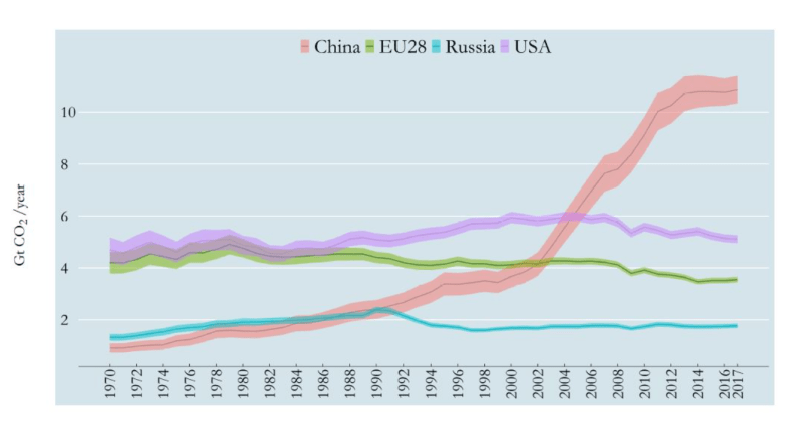
Biggest CO2 emission change in EU was mainly related with reduced heavily polluting manufacturing activities and partial transformation of coal plants. No wonder why China became the place where most of the things and essential parts for the world’s demand are made. EU emission trading system managed to transfer part of carbon dioxide to other places of the world. Where carbon emission not only isn’t controlled but no clear limitations of pollution are introduced at all.
US is still far behind with an introduction of any type of CO2 tax. Till now government is focusing on the tax reduction policy if sustainable energy resources are explored. However, any type of carbon dioxide regulation mechanism is in debate for decades without any clear path for nearest enforcement.
Big part of the world economies are lacking major regulatory rules, traceability, effective and encouraging laws for energy transformation stages, and many other incentives to make climate change goals at least clearly visible and measurable. How can we cut of a head for the dragon if we don’t know how many heads he has and what he is capable of in general?
What’s next?
Upcoming years will be full of surprises. When we will face the reality, where we will be choosing less damaging scenario from more harmful ones in general. Green energy approach will need to adopt to stay alive. On the verge of the new year celebration of 2022, EU Commission proposed new law to label world’s most widely used fossil fuel natural gas and nuclear power as green energy sources.
It won’t be very surprising if in the near future with the help of some “extra filters” oil will be called a sustainable source of energy for at least some transitional period as well. Economy development dynamics is still the number one agenda in all countries. And shock therapy for it probably will come from the outside circumstances and not conscious decisions made by the leaders in advance.
When general election times are coming, please keep in mind that your vote could make changes to the political direction if it will be clearly heard.