
For years fairy tales have helped individuals to understand and a bit easier integrate archetypal images from our unconscious to conscious. Mystical, theological, fictional stories, that were a bigger part of daily life, at least partially fulfilled a void of symbolically expressed substantial composite of human soul. Where many unknown characters are constantly living in our minds, and we are projecting them onto many objects from our life. As famous statement “God is dead” by Friedrich Nietzsche emphasized the western individual has lost a fundamental part it’s humanity and connectivity to its inner world. I wonder, how we are replacing Gods and heroes these days.
Very often core psychic archetypes are preoccupied by materialistic objects, related to different classes of assets. Fairy tale magical scenarios fulfilled with luck, chances, and mysticism land straight on a quite well mathematically measured objects, such as material fortune components.
Unrealistic values elevation
There are so many factors that influence fluctuations of different asset prices and would be too unrealistic to describe all of them. However, would like to elaborate more on a few tendencies that recently caught my eye.
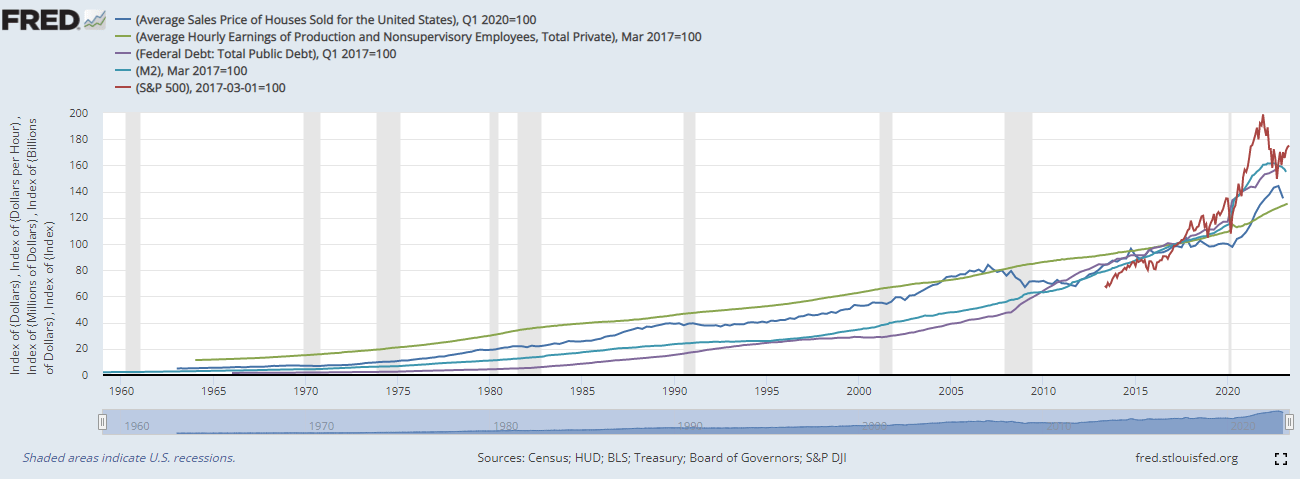
Source: https://fred.stlouisfed.org/
Prices of different assets tend to fluctuate quite significantly during different time periods. However, overpriced items seem not to be able to hold the positions firmly and eventually valuations go down. On the opposite scenario, salaries and standard of living can very quickly pick up the pace to smooth out a high deviation between mispricing.
From the graph above we can observe that at this moment, divergence between selected parameters is quite substantial. This situation is signaling an increased probability of significant correction in the short/mid future term. And when central banks are furiously targeting high inflation, including the growth of wages, the outcome of correction in the valuation of major assets group prices, such as stocks, bonds, and real estate, is highly probable.
The big influence of price changes of real estate and stocks during the last decade lies on the shoulders of drastically increased government debt and money supply. These financial sources became a meaningful help for financial institutions not only expand the pool of their money and liquidity but to invest in extraordinary number of new projects, stocks, bonds and add other different type of things. Pushing prices up together with their dependencies on these inflated valuations. Even if their balance sheets don’t share a big portion of illiquid products, loans remain very much dependent on valuations of many long-term projects and assets purchased by the clients.
The bumpy development of the revaluation reality might be encrypted in The Fisherman and His Wife fairy tale by Jacob and Wilhelm Grimm
Let’s quickly run through the story. Once upon a time a fisherman and his wife poorly lived in the filthy shack near the sea. Once his hook went to the bottom of the sea and he had caught a large flounder. The flounder was an enchanted prince and asked for the release. Fisherman released the flounder and, at the same evening, told the story to his wife. Next day the wife sent out the fisherman to find the magical flounder and ask for a better house. A miracle happened! However, the story continues in the same circle of events, where the wife constantly becomes frustrated with a drastically improved material situation and every time asks for more. Eventually, after the wife has asked to become a God, the flounder takes everything from the fisherman family and the couple goes back to an old life in the filthy shack near the sea.
The core and the most directly visible story moral is about greed. Which is very relevant in asset valuation situations. However, this time I would like to direct the focus more into the emptiness of the wife’s soul. The void was so deep that any kind of reality check and perception of life happenings were simply turned off.
In the fairy tale, from the wife’s corner, there weren’t any moments where the current situation would be evaluated from the perspective of the past or present. All assessments were driven by dissatisfaction, raised from future materialistic dreams. Unfortunately, these dreams were not filling the gap of material life shortages but all other possible gaps of human life without any ability to do the fulfilment. It might be a mission impossible to fill real material shortages with good words or emotions and vice versa.
Current potential overvaluations of different assets indicate a close parallel to the fairy tale above. When more and more individuals begin behaving as a fishermen’s wife, the trajectory of prices becomes steeper and steeper. However, the end of the story is inevitable, with some room for the adjustment of the magnitude. In last decays we saw that governments of different countries have put big efforts to soften the reality of endings of the fairy tales of our life.
These traps are very common in many parts of our existence and not limited by a case of financial behavior. There is not any easy antidote for curing the void of the soul and plenty of different options coexist. However, positive results become more visible just after the deep hole of the soul becomes more visible and addressed. Then the prisoners of this gap, in our case ability to evaluate material side of the fortune, can get a new chance to exist in more actual and responsive reality.