
How many fixed or repaired items at home do you have? My personal answer was almost none as the only thing I could remember was a pair of shoes, fixed one year ago. This reality is probably very similar to many. Especially when the item is less expensive, the easier we can replace it with new one. We have developed the saying which was not relevant 30-40 years ago: it’s cheaper to buy a new thing than finding someone to fix it.
The concept of an economic model where issues of products repairing and reusing are addressed together with big emphasis on recycling, is called the circular economy. In the broader sense the circular economy is a model of production and consumption, which involves sharing, leasing, reusing, repairing, refurbishing and recycling existing materials and products as long as possible. It makes the life cycle of products more extended. Yong Geng proposed mostly accepted definition – “an economy which is based on spiral-loop system that reduces energy-flow, matter and environmental degeneration without hindering the social and technical progress or economic growth”.
EU parliament on February 2021 adopted a resolution on the new circular economy plan with the vision of full implementation by 2050. Till this day the plan still sticks closer to definitions acknowledgment stage than to a concrete execution content. However, few months ago EU approved new rules, which are called “Right to Repair”. Requirements, demanding that all new devices have to come with repair manuals and be made in such a way that they can be dismantled using conventional tools. In addition, manufacturers should ensure that parts are available for up to a decade. That sounds like a beginning of a legal foundation for creation of repairing principals in our daily lives.
According to the World Business Council for Sustainable Development, a circular economy could have a significant impact on commercial opportunities that could reach $4.5 trillion. Including new industries, jobs and natural resources efficiencies. Far-sighted approach of the economy is based on minimization of expenditures for resources by increasing productivity or reducing the need in general. Big advocate of the circular economy an Ellen MacArthur foundation has estimated that EU could reduce spending on resources by €600 billion and increased productivity of existing ones would bring benefits up to €1.8 trillion.
Benefits of the switch of current economic model theoretically are very beneficial and long lasting. However the implementation of precise actions is still very far behind. We are just now implementing new laws and regulations as mentioned above “Right to Repair” and still completely missing full infrastructure to make these ideas implemented.
Finding clothing or shoes repair spot is a challenging quest comparing with a possibility to buy a new one. Encouragement to provide this service on a side for all goods sellers would make a difference for all buyers. Spare parts of electronic devices should be selling next to the new devices. Tradition and culture of fixing, repairing and adjusting must be promoted and seen on every goods selling point. Just then we will be closer to the development of a habit—to buy a new thing after all other options were explored.
Considerations of totally new ideas how to improve our behavior from the perspective of the circular economy clashes with inevitably and extremely potent obstacles of our economy. Present engine of the global economy is heavily dependable on all manufactures and product developers of all industries. And almost all of them currently are building their businesses on revenues from sales and not maintenance.
If we will take an example of Apple, one of the flagman of all innovative businesses, we will be surprised, how much efforts are put by the company into the creation of struggles to users to enforce them to buy new products. It took several lawsuits and probably a decade for apple to make phones with a replaceable battery. Just last year Apple lost a $500 million law suit for an intentionally organized software change, that slows down performance and reduces battery life in older phones. Every new emerging opportunity for users to delay or skip a purchase option is always automatically per-blocked by the manufacturer. Only with a hard work and push from the society the interests are sometimes defended. It’s a pity, that governments generally are not on the side of the regular people and most of legislative actions are implemented after courts rulings.
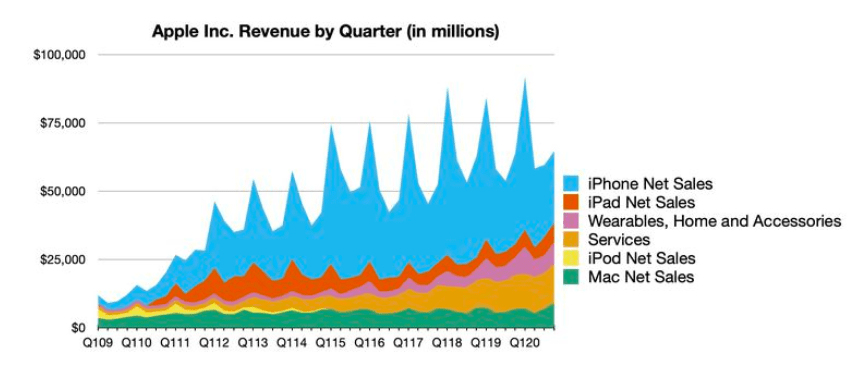
Bellow you can find Apple revenue composition graph through the years. Revenues from services just recently have reached 20% mark. For the company that is selling most expensive, popular and admired mass-personal electronic devises for more than a decade.
Source: Macrumors.com
Our economy, heavily based on consumption, has grown up a significant number of extremely powerful and influential business all around the globe. What have made them a very important part of all global economy engine with a huge influence for politics and consumers. That is why all different enforcing laws as “Right to Repair” are so slowly moving upfront. We still have so many gaps that need to be filled by lawmakers to make circular economy ideas more realistic and convenient for all of us.
An important idea that should be addressed by all governments is how to make repair, reuse or sharing activities much more natural and attractive for people and businesses. Both, from an ideological and financial point of view. Redirection of money wisely from direct sales of goods to explicit packages of related services might be the solution satisfying all sides. The change must be gradual and fast.
Unfortunately, currently prevailing an uncompromising consumption looks hardly stoppable. Even with a slight consideration of circular ideas, full range of businesses would be interpreted as not going forward with the competition. This attitude includes most of industries ranging from electronic devises, that are introducing new models every year, to fashion industry, that is changing trends at least twice a year. Although, we cannot unilaterally blame the corporate mindset for the reckless behavior. The behavior that is creating jobs and well-being for all of us and meaningfully supporting budgets of our governments.
One of the fundamental goals of circular economy is a reduces usage of natural resources. The objective is for sure a sustainable and visionary idea but once again benefiting firstly rich manufacturing countries. At least in the beginning it will raise new challenges and poverty issues in poorer counties and that situation might stay for longer periods. Big part of natural resources of the planet are brought to the global market by low-income countries and most of them are eligible for the term “poverty paradox”. Where people are facing smaller economic growth, lack of democracy and slower overall development, independently of the riches the country has. That is what we see in a big part of Africa or South America.
Current inequality is already bringing risks related with an increased refugees migration all around the world, famine and military conflicts. Decreased income from natural resources export might inflame these tensions to extreme levels. With inevitable chaotic national and international war conflicts.
The complexity of the economy makes the swift to the circular way of behaving a very challenging task. Which requires time, craftsmanship, dedication and concentration. Unfortunately, the qualifications that we cannot so easily brag about. Specially, at the decade when climate change is beginning to show it’s teethes to all humanity.